
History of Acoustic Liquid Handling
Published: oktober 27, 2026
How Acoustic Liquid Handling Evolved into a Reproducible Scientific Method
Acoustic liquid handling became a scientific method by replacing contact-based transfer with acoustic droplet ejection, enabling precise nanoliter-scale dispensing without tips, nozzles, or physical contact. Over time, advances such as Dynamic Fluid Analysis and acoustic tube-based sample management expanded the technology from plate-based dispensing into reproducible workflows for compound management, assay miniaturization, and automated laboratory systems.
At the turn of the millennium, automated liquid handling was scaling into ultra-high-throughput applications, but most workflows still relied on contact-based transfer. Pipette tips, pintools, serial dilution, dead volumes, and cumulative volumetric error created practical limits for assay miniaturization and compound management.
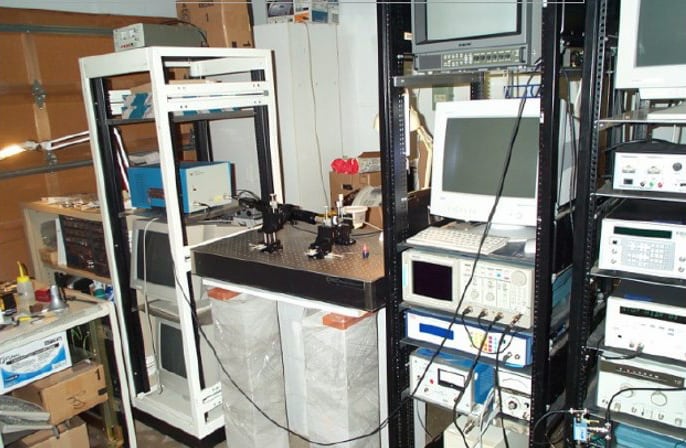
Figure 1: Research instrumentation in the original Picoliter startup lab in Cupertino, CA.
In 2000, Labcyte challenged this prevailing paradigm. The hypothesis was straightforward: if acoustic energy can eject ink droplets in printing, can it be applied to biological liquids to enable clean, reproducible transfer while preserving molecular integrity?
Turning that concept into a reliable scientific method required more than applying a known physics principle; it required developing an instrument platform that could transfer diverse liquids consistently under real experimental conditions.
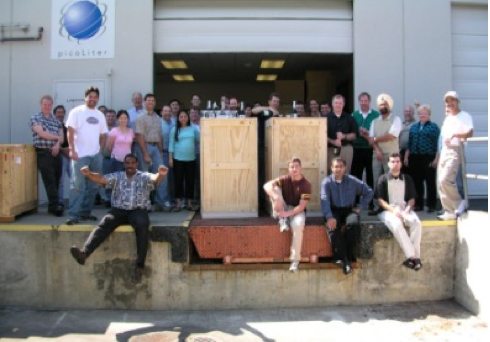
Figure 2: The early Labcyte team celebrates on the loading dock as the first Echo 550 instruments ship out—a milestone moment filled with pride (and hopefully not nanoliter-scale champagne dispenses) for the group.
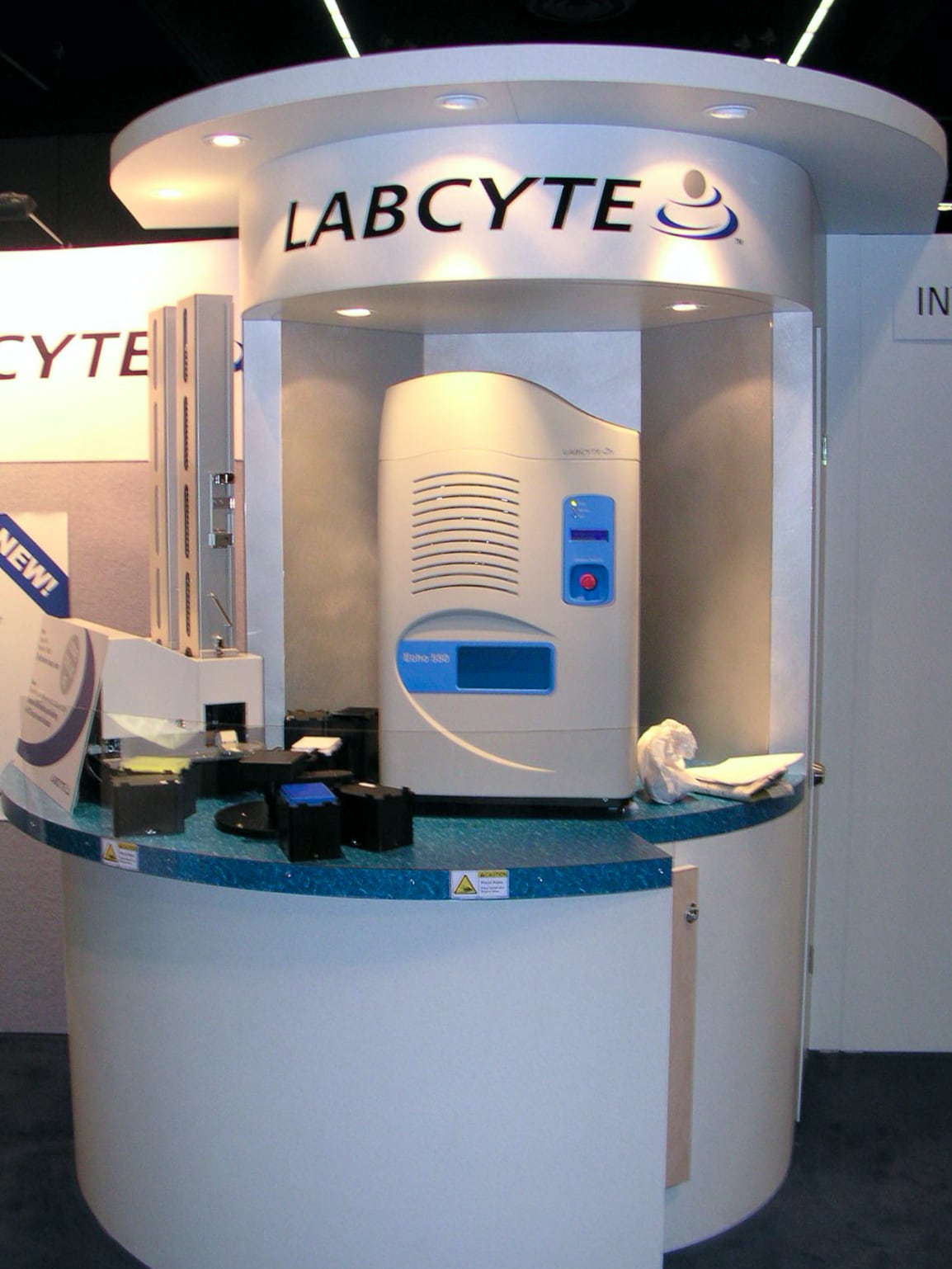
Figure 3: The Echo 550 instrument being prepared for display at SBS 2003.
2004: From Concept to Scientific Method
The release of the first Echo Acoustic Liquid Handler by Labcyte in 2004 marked a turning point in liquid handling technology. This development did not merely introduce a new instrument; rather, it established an alternative transfer paradigm based on acoustic droplet ejection.
For the first time, library-scale liquid transfer could be achieved:
- Without physical contact
- Without the use of consumables such as tips or nozzles
- Without reliance on serial dilution to achieve concentration gradients
- With highly consistent nanoliter-scale dispensing volumes
Acoustic liquid handling addressed limitations of contact-based approaches by enabling precise, non-contact transfer with high repeatability and reduced sources of error. As a result, the technology facilitated the reliable miniaturization of assays while preserving data integrity.
This capability marked a critical transition, allowing researchers to implement nanoliter-scale workflows with confidence under real experimental conditions, and establishing acoustic transfer as a viable and scalable scientific method.
Making Acoustic Transfer Reproducible
Early acoustic liquid handling systems proved feasibility, but routine reproducibility across fluids with different physical and chemical properties required further innovation.
What made early acoustic transfer difficult?
- Fluid properties: viscosity, surface tension, solvent composition, and DMSO hydration state
- Sample composition: aqueous buffers, surfactants, proteins or enzymes, glycerol-containing formulations, and chemically diverse compound libraries
- Consumable design: resin composition, plate geometry, and manufacturing precision
Key Breakthrough: Dynamic Fluid Analysis (DFA)
Dynamic Fluid Analysis, released in 2012 on Echo 550 series instruments, helped address this variability by assessing each sample in real time and adjusting acoustic energy accordingly. This enabled more consistent droplet ejection across liquids with different properties.5
Result: Acoustic liquid handling can support reproducible dispensing across fluids with different physical and chemical properties, including:
- High-surface-tension aqueous solutions, such as pure water and aqueous buffers
- Reduced-surface-tension formulations, including surfactant-containing solutions whose behavior may vary near or above the critical micelle concentration
- Higher-viscosity biological reagents, such as enzyme solutions stored in glycerol-containing formulations (up to 50% glycerol equivalence)
- Libraries of fluids with variable properties such as crystallography reagent kits
- Chemically diverse compound libraries, where compounds may differ in solubility, lipophilicity, and transfer behavior
By accounting for both liquid behavior and consumable design, this advancement helped transform acoustic transfer from a promising capability into a more reliable scientific method.
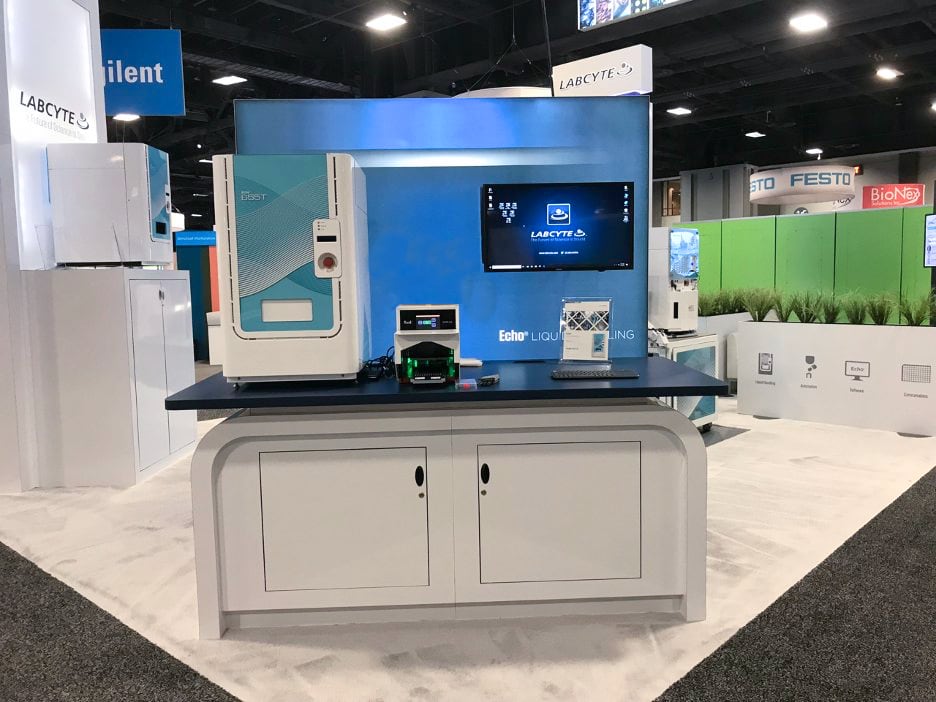
Figure 4: The acoustic sample tube-enabled Echo 655T instrument being readied for display at SLAS2019.
Why Sample Management Needed to Change
By the early 2010s, drug discovery groups faced a new sample-management challenge: larger collections, limited storage footprint, the need to preserve sample longevity, and growing demand for access across internal teams and external collaborations. In 2017, AstraZeneca reported more than two million compounds in storage, with more than 150,000 at risk of depletion and an estimated replacement cost of $50–$100 per compound.1, 2 To address these challenges, a consortium formed in 2015 between AstraZeneca, Brooks Life Sciences (now Azenta Life Sciences), Titian Software (now Cenevo), and Labcyte (now part of Beckman Coulter Life Sciences).1 The group developed an integrated approach to increase sample longevity, improve storage density, and facilitate sample access. From this partnership came the Acoustic Sample Tube and tube-enabled Echo instruments, including the 650T, 655T, 650T Plus, and 655T Plus.2, 4 The concept has since been adopted by other pharmaceutical and biotechnology organizations, supporting long-term compound storage and easier access to samples in Acoustic Sample Tubes.2
Changing Compound Management
As the Echo Acoustic Liquid Handler matured, its impact extended beyond dispensing to fundamentally reshape compound management.1, 2 Traditional approaches relied on:
- Large stock volumes
- Multiple intermediate plates
- Repeated freeze-thaw cycles
- Serial dilution with cumulative error
The Echo platform enabled a different approach:
- Direct dilution rather than serial dilution
- Fewer intermediate steps
- Dramatically reduced compound and DMSO consumption2
- Improved preservation of library integrity
With the expansion of acoustic workflows to tube-based handling and automation, researchers increasingly optimized storage through high-density tube formats and gained the ability to dynamically reformat libraries, selectively accessing compounds as needed.2, 4
The use of acoustic tube collections enabled:
- Reduced collection footprint, allowing organizations to distribute and secure compound collections across multiple storage sites
- Reduced DMSO consumption
- Ability to build screening collections on demand by cherry-picking tubes
From Labcyte to Beckman Coulter
By 2019, acoustic liquid handling had evolved from a specialized innovation into a strategically important technology platform.3
The acquisition of Labcyte by Beckman Coulter Life Sciences was not intended to redefine the underlying science, but to expand its scale and accessibility through integration into a global ecosystem of automation, software, and laboratory systems.
The science remained the same, while its reach expanded.
The Original Authority
From a garage-born idea in 2000 to a widely adopted automation platform, Labcyte—now part of Beckman Coulter Life Sciences—played a defining role in industrializing acoustic liquid handling.
This is where acoustic liquid handling moved from an early concept toward a reliable method for scientific workflows.
References
- Green C. Technology Innovation Will Help Prepare Drug Discovery for Smart Screening Era - Drug Discovery World (DDW) [Internet]. 2017 [cited 2026 Jun 5]. Available from: https://www.ddw-online.com/technology-innovation-will-help-prepare-drug-discovery-for-smart-screening-era-1137-201712/
- Acoustic tube sample management [Internet]. [cited 2026 Jun 5]. Available from: https://www.astrazeneca.com/r-d/our-technologies/acoustic-tube-sample-management.html
- Labcyte was acquired by Beckman Coulter Life Sciences [Internet]. [cited 2026 Apr 23]. Available from: https://www.beckman.com/news/labcyte-acquisition-to-expand-laboratory-automation-business
- Echo Acoustic Liquid Handlers | Nanoliter Dispensing [Internet]. [cited 2026 Apr 23]. Available from: Echo https://www.beckman.com/liquid-handlers/echo-acoustic
- Labcyte Advances Automatic Acoustic Liquid Handling with Dynamic Fluid Analysis [Internet]. Technology Networks. [cited 2026 Jun 18]. Available from: https://www.technologynetworks.com/analysis/product-news/labcyte-advances-automatic-acoustic-liquid-handling-with-dynamic-fluid-analysis-219422
FAQs about Acoustic Liquid Handling history
How did acoustic liquid handling originate?
Acoustic liquid handling originated from the idea that sound waves used in printing could be adapted to transfer biological liquids without contact.
What problem did acoustic liquid handling aim to solve?
It addressed limitations of contact-based methods, including contamination, high consumable costs, sample loss, and variability in liquid transfer.
When was acoustic liquid handling first commercialized?
It was commercially introduced in 2004 with the launch of the first Echo Acoustic Liquid Handler.
What made early acoustic liquid handling challenging?
Achieving consistent droplet transfer across fluids was difficult due to variations in liquid properties such as viscosity and surface tension.
What advantages does acoustic direct dilution offer over serial dilution?
In serial dilution, physicochemical properties of the stock solution, such as lipophilicity or stickiness, can cause unwanted adsorption to a pipette tip. When the tip transfers sample to a subsequent well or tube, adsorbed material may carry over and contribute to compounding error propagation and inaccurate dose-response results.
In contrast, acoustic direct dilution is non-contact, so it can reduce tip-related adsorption and carryover. When stock solutions are homogeneous and workflows are properly validated, this approach can improve concentration accuracy and support reproducible potency and affinity measurements.
What types of fluids can acoustic liquid handling dispense?
Acoustic liquid handling can support reproducible dispensing across aqueous buffers, surfactant-containing solutions, viscous biological reagents, chemically diverse compound libraries, DMSO-based samples, and reagent sets with variable fluid properties.
How did acoustic liquid handling change compound management?
It enabled direct dilution, minimized compound consumption, and improved sample integrity. In AstraZeneca’s acoustic tube-based sample management workflow, reported improvements included:
- Sample accession capacity increased from 20,000 per day to 80,500 per day
- Storage density increased from 12,830 samples/m3 to 34,717 samples/m3
- Stock storage volumes were decreased over 10-fold (from 900 µL to 85 µL)
- Compound consumption in a typical bioassay was reduced by 90% (from 30 µL to 2 µL)
- Hazardous waste generation was reduced by 93% (1750 L of DMSO down to 300 L)
- The longevity of 150,000 samples at risk of depletion was extended
How did the Beckman Coulter acquisition in 2019 influence the technology?
It scaled accessibility and integration into automated laboratory ecosystems without changing the core science.
Loomis & Wood demonstrate ultrasonic droplet ejection — the scientific foundation of Acoustic Droplet Ejection (ADE).
Rise of high-throughput screening (HTS), genomics, and laboratory robotics, with adoption of 384- and 1536-well plates.
Problem space defined — the limits of contact-based liquid handling become clear.
Conceptual application of acoustic energy to biology-relevant fluid transfer.
Labcyte founded.
ADE becomes practical for laboratory use.
First Echo Acoustic Liquid Handler launched.
Refinement of acoustic transfer techniques in biology.
Echo 555 (2006) launched.
Recognition of fluid variability challenges in acoustic transfer.
Dynamic Fluid Analysis (DFA) introduced.
Scaling needs emerge for automated assay-ready plate (ARP) creation.
Launch of the Access Workstation — Echo-centric end-to-end ARP automation.
Demand for precise nanoliter dispensing grows in genomics and other aqueous workflows.
Echo 525 launched.
Scaling compound storage and access.
Acoustic tube-based workflows introduced; Echo 655T and DRS automation systems launched.
Acoustic liquid handling recognized as a platform technology.
Labcyte acquired by Beckman Coulter Life Sciences.
Increasing demand for robust dataset generation.
Release of the Biomek Echo One Bundled Solution; approval of first TPD.
Integration of sensing and machine learning into instrumentation.
Echo 650 Plus launched (DFA2, Next Generation Transducer).
Talk to an Expert
Echo Acoustic Liquid Handlers
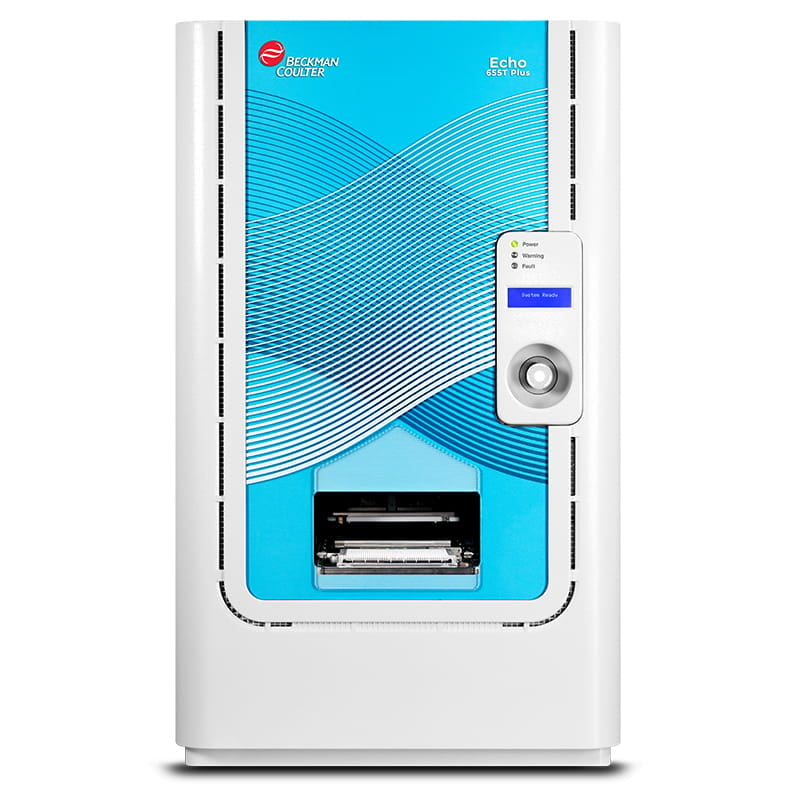
Echo 650 Plus Series Acoustic Liquid Handlers
High‑Throughput, Non‑Contact, Accurate, and Precise Liquid Dispensing with Volumes as Low as 2.5 nL

Echo Plate Reformat Software
Echo Plate Reformat software offers a variety of liquid transfer functions, including assay plate replication, library compression, & customization.

Echo Cherry Pick Software
Echo Cherry Pick software enables transfers of any volume of liquid from any source well into any destination well.

Echo Dose-Response Software
Echo Dose-Response software provides a simple step-wise process for designing assay plate layout and creating dose-response curves.


